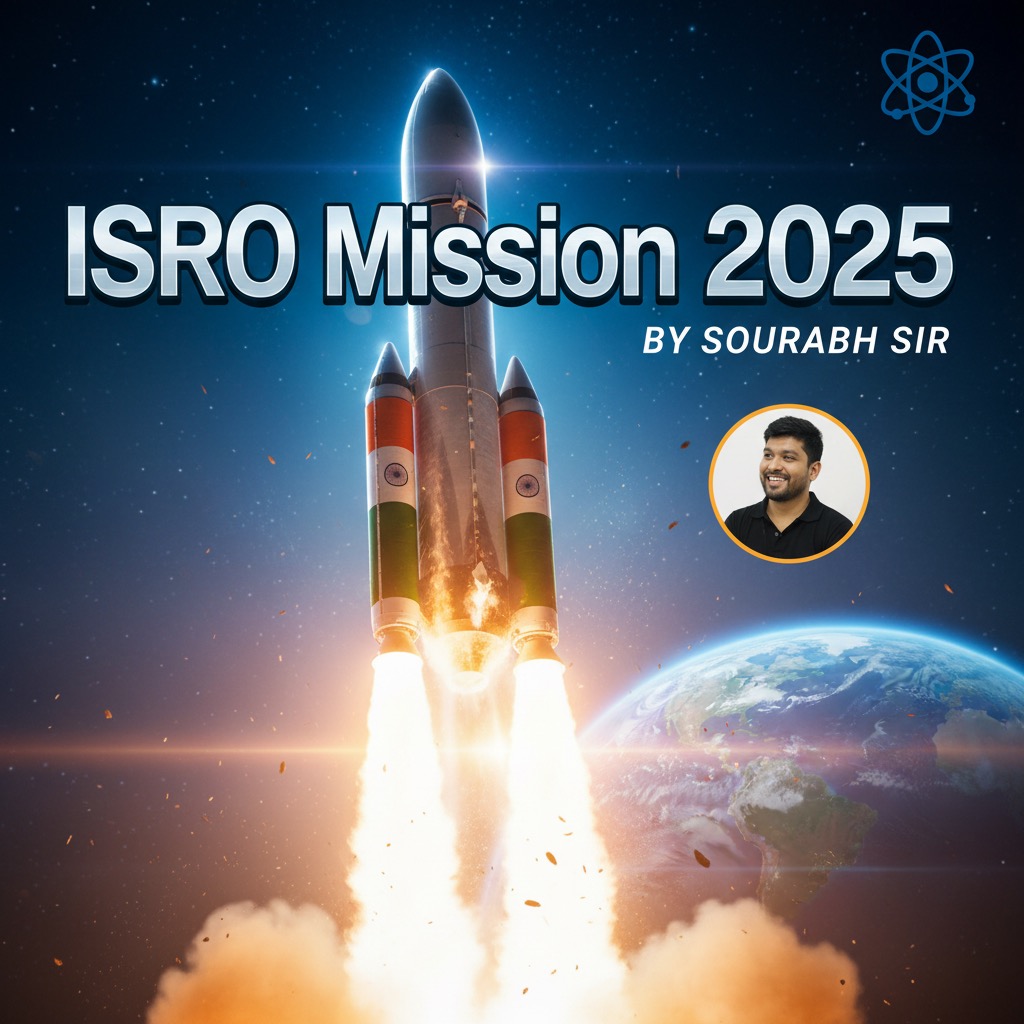
India’s space agency, ISRO, continues to push global boundaries — and 2025 is shaping up to be one of the most exciting years in India’s space journey. Whether you’re a science student preparing for JEE/NEET, or simply fascinated by space, ISRO’s 2025 missions offer incredible lessons in physics, engineering, and innovation.
This blog breaks everything down in simple, exam-friendly language.
🌍 1. What Is ISRO Planning in 2025?
ISRO is focusing on three major areas in 2025:
✅ 1. Human Spaceflight (Gaganyaan Progress)
- More uncrewed test flights
- Testing life-support systems, re-entry modules, parachute systems
- Preparing for India’s first manned space mission
✅
2. Advanced Satellite Launches - Next-generation Earth observation satellites
- Climate monitoring and agriculture-support satellites
- Improved navigation systems (NavIC upgrade)
✅ 3. Deep Space Exploration - Work on Chandrayaan next-phase, lunar mapping tech
- Early development for Mars Orbiter Mission-2 (Mangalyaan-2)
These missions mix astronomy + physics + engineering — perfect for science students to learn from.
🚀 2. The Star Mission of 2025: Gaganyaan Test Flight
Gaganyaan is India’s dream project to send Indian astronauts into space.
In 2025, ISRO will conduct:
⭐ Test Flight with Robot ‘Vyommitra’
A humanoid robot capable of:
- Monitoring spacecraft systems
- Communicating with ground control
- Performing simple operations
🔭
3. Earth Observation Satellites: Helping India from Space In 2025, ISRO will launch new satellites designed for:
🌦 Weather forecasting
Better tracking of monsoons and cyclones.
🌱 Agriculture
Monitoring crop health, predicting yield, detecting drought.
🌍 Environmental studies
Mapping pollution, deforestation, glaciers, and sea-level rise.
📡 Navigation
Improving accuracy of NavIC — India’s own GPS.
🌑 4. Mars & Moon: The Next Big Steps
🌕 Lunar Missions (Post-Chandrayaan)
ISRO is working on:
- Enhanced lunar lander tech
- Better rover systems
- New instruments for studying moonquakes and lunar minerals
🔴 Mars Orbiter Mission-2 (Mangalyaan-2)
Expected developments in 2025:
- Orbiter design finalisation
- Better communication systems
- New sensors for studying Martian atmosphere
This shows India’s growing strength in planetary science.
🧪 5. What Science Students Can Learn From ISRO’s 2025 Missions 1️⃣ Real-Life Applications of Physics
- Orbital mechanics
- Escape velocity
- Re-entry thermodynamics
- Rocket propulsion equations
2️⃣ Engineering Skills - Cryogenic engines
- Robotics (Vyommitra)
- Satellite hardware & sensors
- Materials that survive extreme heat
3️⃣ Innovation & Problem-Solving ISRO is famous for:
- Low-cost missions
- High reliability
- Using indigenous technology
Perfect inspiration for young engineers.
📖 6. ISRO’s 2025 Mission: Summary for Exams
Important points to remember:
- Focus on Gaganyaan test missions
- Upgrades to NavIC navigation system
- New Earth observation satellites
- Progress on Mars and Moon missions
- Key technologies: cryogenic engines, crew module, heat shield, satellite imaging
🧑🎓 7. Why Every Science Student Should Follow ISRO Because ISRO shows that:
- Science isn’t just theory — it’s innovation + creativity
- India is becoming a global leader in space
- Students today can become the scientists of tomorrow
If you’re preparing for JEE, NEET, CUET, or science olympiads, ISRO’s missions offer real-world examples to strengthen your concepts.
✨ Conclusion ISRO’s 2025 missions are not just about rockets — they represent India’s future in space science.
Understanding these missions helps students:
- Build strong fundamentals
- Stay motivated
- Discover new career paths
The sky is not the limit — it’s just the beginning. 🚀


 Launch your Graphy