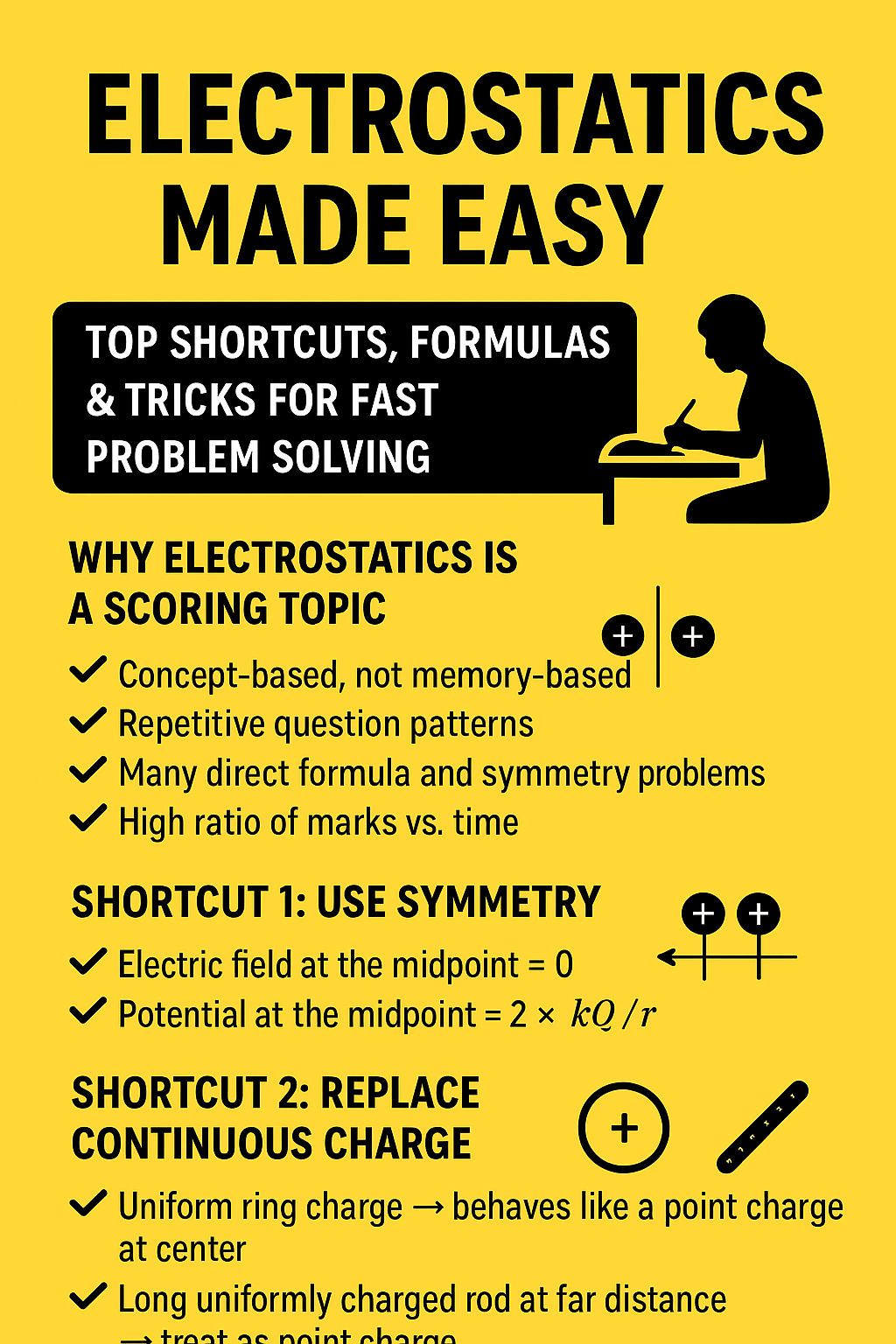
📍Potential at the midpoint = 2 × (kQ/r)
Where it helps in JEE
- Square/rectangle charge arrangements
- Ring of charge
- Spherical shell problems
Using symmetry saves huge time because field directions cancel automatically.
⚡
Shortcut 2: Replace Continuous Charge with “Effective Charge” Instead of integrating long expressions, convert the system into a simpler equivalent charge.
Examples
- Uniform ring charge → behaves like a point charge at center for potential.
- Long uniformly charged rod at far distance → treat as point charge.
This trick converts lengthy calculus into simple kQ/r formula.
⚡
Shortcut 3: Memorise and Apply Super-Important Standard Results Some formulas appear again and again. Instead of deriving, you should apply directly.
Must-Know Results
• Electric field due to a ring (axis):
E = \frac{kQx}{(x^2 + a^2)^{3/2}}
• Electric field due to infinite line charge:
E = \frac{\lambda}{2\pi \varepsilon_0 r}
• Electric field inside a spherical shell:
E = 0
• Potential due to electric dipole:
V = \frac{p\cos\theta}{4\pi\varepsilon_0 r^2}
These directly solve 80% of JEE problems.
⚡
Shortcut 4: Use Vector Addition Smartly Electric fields are vectors → use geometry for fast calculation.
Shortcut Angles - 90° addition → E_{\text{net}} = \sqrt{E_1^2 + E_2^2}
- 120° addition → E_{\text{net}} = \sqrt{E^2 + E^2 + EE} = E\sqrt{3}
- Opposite direction → subtract directly
These appear frequently in square/triangle charge arrangements.
⚡
Shortcut 5: For Conductors — Remember Two Golden Rules ✔ Rule 1: Electric field inside a conductor = 0
✔ Rule 2: Charge always resides on surface
Using these rules: - If charge is placed inside cavity → induced charges appear on inner & outer surface
- Potential remains constant throughout the conductor
These shortcuts directly eliminate wrong options in MCQs.
⚡ Shortcut 6: Use “k = 9 × 10⁹” Smartly for Calculation
Instead of full calculations, use approximate shortcuts:
- 9×10^9 ≈ 10^{10} (for rough estimates)
- Or use mental math:
9→(10-1) trick for multiplication
This reduces long calculations to 2–3 steps.
⚡
Shortcut 7: Electric Dipole Short Tricks At axis of dipole:
E = \frac{2p}{4\pi\varepsilon_0 r^3}
At equatorial line:
E = \frac{p}{4\pi\varepsilon_0 r^3}
Shortcut Logic: Axis field is double of equatorial field.
Helps reduce conceptual confusion in JEE Advanced problems.
⚡
Shortcut 8: Remember the “Gauss Law Shapes Formula” Instead of integrating, use the Gauss Law patterns:
Infinite line charge → Cylindrical surface
E = \frac{\lambda}{2\pi \varepsilon_0 r}
Infinite plane sheet → Gaussian pillbox
E = \frac{\sigma}{2\varepsilon_0}
Spherical shell → Gaussian sphere
Inside = 0 Outside = \frac{kQ}{r^2}
Knowing which shape to apply eliminates long derivations.
📌
High-Yield JEE Main Problem Types - Electric field at corners of square/triangle
- Force between charged particles
- Potential of ring/sphere
- Capacitor basics
- Gauss law direct formula questions
📌 High-Yield JEE Advanced Problem Types
- Non-uniform charge distribution
- Superposition + vector addition based questions
- Field on axis of complex shapes
- Multi-step potential + energy problems
📘
Final Tips to Score High in Electrostatics - Practice 50–70 previous year questions
- Use symmetry to cut calculation time
- Don’t derive standard results in exam
- Draw field direction before applying formulas
- Use approximations smartly in calculations
Conclusion Electrostatics becomes easy when you work smart instead of solving everything traditionally. With the above shortcut methods, you can solve even tough questions in seconds. These tricks are not only exam-friendly but also help build intuition for advanced Physics concepts.


 Launch your Graphy