There are no items in your cart
Add More
Add More
| Item Details | Price | ||
|---|---|---|---|

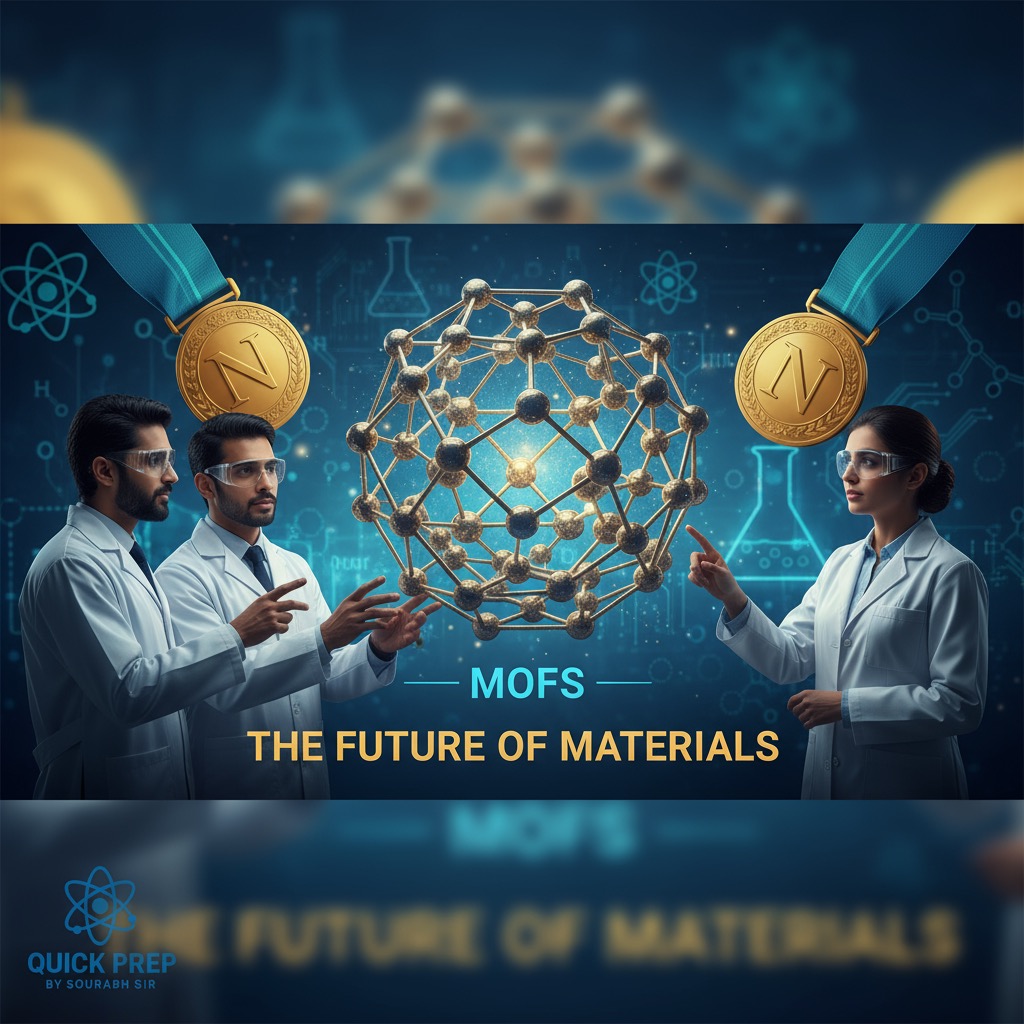
🏅 When Empty Spaces Became Powerful: The 2025 Nobel Prize for MOFs
In 2025, the Nobel Prize in Chemistry was awarded to Susumu Kitagawa, Richard Robson, and Omar M. Yaghi for their pioneering work in creating Metal–Organic Frameworks (MOFs) — one of the most versatile materials discovered in modern chemistry.
🔬 What Are MOFs?
MOFs are crystal-like networks made of metal ions (the “nodes”) connected by organic molecules (the “linkers”). This creates tiny, repeating cages or pores, giving MOFs an enormous internal surface area — so large that just one gram can cover a football field!
These pores act like mini storage units, capable of holding, filtering, or reacting with specific molecules. By choosing different metals or linkers, scientists can “tune” these structures for almost any task.
🧱 The Journey of Discovery
Richard Robson first built porous coordination networks in the 1980s, showing that such frameworks could be stable.

{{AUTHOR}}
CHEMISTRY EDUCATOR FOR JEE AND NEET
 Launch your Graphy